News Story
Optics Breakthrough Could Yield Swifter Communications

Assistant Professor Avik Dutt, University of Maryland.
In a major advance in the field of optics, University of Maryland (UMD) Assistant Professor Avik Dutt and research colleagues have demonstrated a new way to control light precisely by using microscopic structures created on the surface of hair-thin glass fibers.
Modern, high-speed communications rely on fiber optic cables, often made of pure silica glass, to transmit data using light. However, light waves are highly sensitive to microscopic flaws in the glass, twists in the cable, or environmental disturbances, which can distort signals and leak valuable data.
To help the waves travel more smoothly, the researchers harnessed ideas from topological photonics—a field that leverages concepts from topology, the mathematics of shapes and their properties, to design unusual and robust ways of controlling light. Their work, detailed in a paper published by Nature Communications, marks the first demonstration of these ideas on this emerging fiber-based platform.
In addition to Dutt, the team includes Army Research Laboratory (ARL) physicist Dashiell Vitullo and Nathaniel Fried, a UMD doctoral candidate and Department of Defense SMART Scholar.
An "Optical Highway" for Light Waves
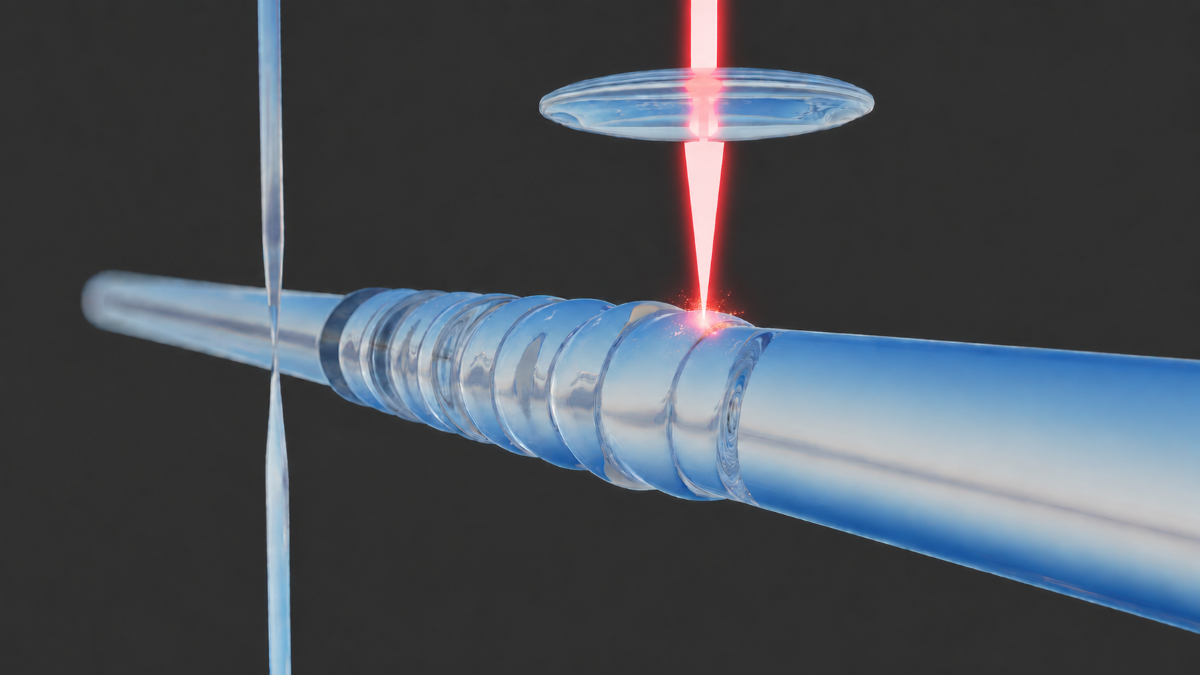
In the approach pioneered by Dutt and his colleagues, ulltra-precise lasers are used to sculpt microscopic bumps, known as microresonators, onto the surface of standard glass fibers. By chaining 21 microresonators together, the team built what they call a “specialized, one-way optical highway” that steers light waves around obstacles and prevents them from degrading or scattering.
By carving different patterns of microscopic bumps onto a single glass fiber with sub-nanometer precision, the researchers created a hybrid boundary. On one side of the boundary, the light-guiding structures are arranged in one pattern; on the other, they follow a different pattern.
Understanding how light behaves when crossing this microscopic border required the team to write an entirely new mathematical blueprint. This formula allows scientists to predict whether light will freeze at the boundary or flow smoothly across it, giving them total control over the signal.
Lower Cost, Improved Durability
Traditional advanced microchips used for routing light are fragile and expensive to manufacture, the researchers noted. Once made, they cannot easily be altered without using power-hungry components that constantly drain energy.
In contrast, the new fiber-optic devices are highly adaptable. If changes are needed after they are made, scientists can simply hit the fiber with targeted laser heat to reshape the microscopic bumps. Once trimmed to the right specification, their configuration is stable and no further energy is required to maintain it.
“These unique capabilities of microbumps, such as adaptable trimming and measuring with minute precision in space, are quite beneficial compared to microchips,” said Dutt, who has experimented with photonic microchips for 15 years and more recently began collaborating with Vitullo to investigate the microbumps.
The glass fibers also suffer almost zero signal loss. They can handle complex light signals without requiring the heavy cooling systems or bulky vacuum chambers common in other advanced quantum hardware.
With the fundamental physics successfully proven, researchers are already looking toward the future. In addition to the microbumps, they are planning to explore nonlinear optical behaviors, essentially using the unique properties of light to create synthetic dimensions. This would allow researchers to manipulate multiple aspects of light simultaneously, vastly increasing the amount of information these fiber systems can carry.
This research was conducted under a Cooperative Research and Development Agreement between UMD and the U.S. Army, through its Combat Capabilities Development Command. According to Vitullo, the breakthroughs achieved by the team could enhance the speed and reliability of military communications networks, pave the way for quantum navigation sensors that do not rely on GPS, and support simulation of advanced materials.
Work was conducted in Dutt’s Fearless Optics, Quantum Engineering, and Technology Group, housed at UMD’s A. James Clark School of Engineering, and at ARL facilities. Dutt holds faculty positions in the Department of Mechanical Engineering and the Institute for Physical Science and Technology.
Published September 29, 2026
Recent Stories
Stories / Oct 14, 2026
Graham Delivers IEEE’s Morton Antler Lecture

Stories / Oct 12, 2026
Han Appointed IEEE EPS Distinguished Lecturer

Stories / Oct 6, 2026
FDA Awards Sochol-Led Team $873K to Build Retina Models

Stories / Oct 5, 2026
Celebrating LGBTQ+ History Month 2026

Stories / Sep 29, 2026
Optics Breakthrough Could Yield Swifter Communications

Stories / Sep 28, 2026
Das Elected Fellow of Royal Society of Arts

Stories / Sep 2, 2026
Agonafer Named ASME Fellow

Stories / Aug 26, 2026
Graham Named Honorary ASME Member

Stories / Aug 25, 2026
Sochol Named Maryland Robotics Center Director

Stories / Aug 24, 2026
Boosting Cybersecurity at Nuclear Plants: Zhao Lands DOE Award
